Agents & Environments
Models that act: over tools, over computers, over long horizons.
1 papers · 11 avg citations
Written by Junkun Yuan.
Click here to go back to main contents.
Table of contents ▼
Retrieval, Memory & Context
VISTA: A Visual Harness for Reasoning in an Interactive World
MIT
arXiv, 2026
Oct 01, 2026 VISTA (11) code (603)
Lossless visual memory and model-directed inspection make a multimodal model an agent that clears all 25 public ARC-AGI-3 games.
Insight. Encode-once perception limits an agent. Keep raw pixels addressable, use context to reason, and ablate the harness like a model.
-
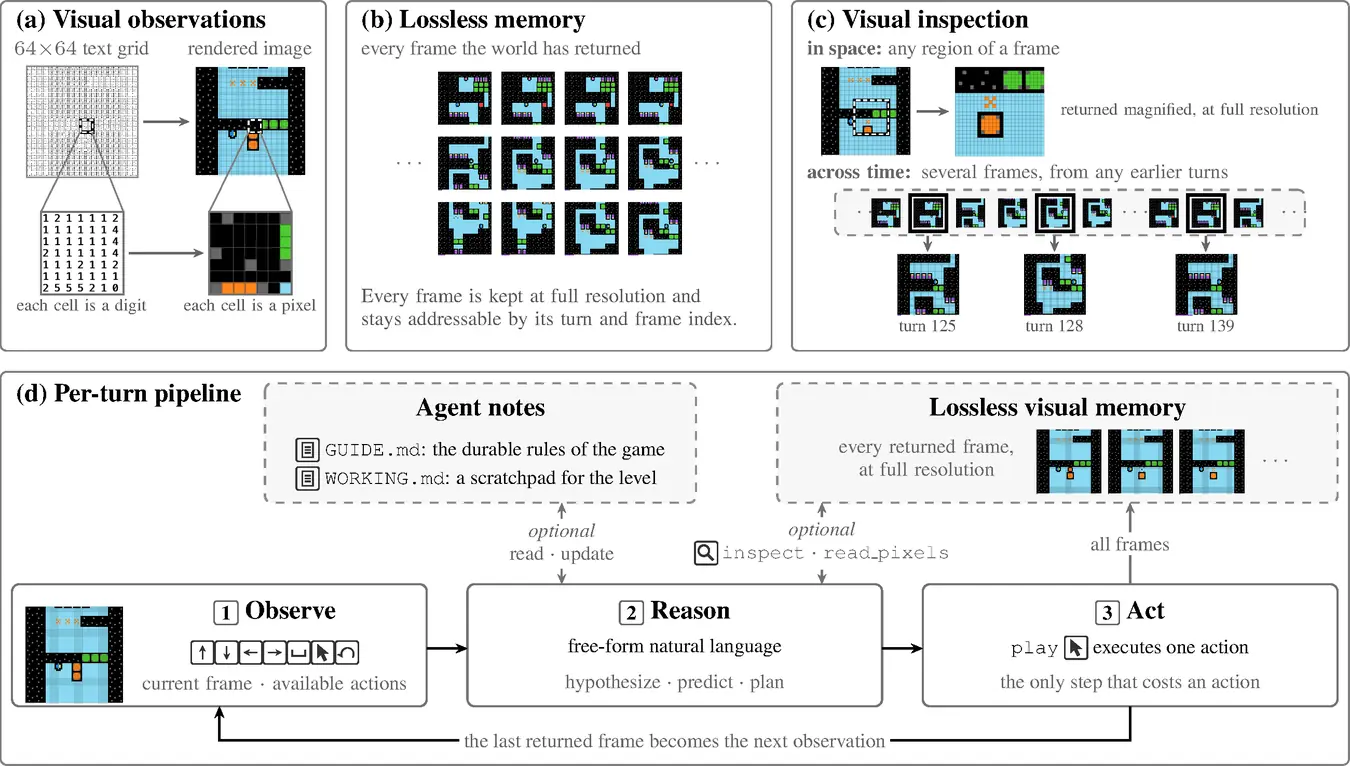
Visual observation (§3.1, Fig. 3a). A 512×512 PNG, the grid upscaled 8×, costs ~308 image tokens. The 64×64 text grid costs ~4K.
-
Lossless visual memory (§3.1, Fig. 3b). The harness archives every returned frame in full, animation frames too, keyed by turn and frame index and addressable after compaction. Only the last frame of an action enters the context, not up to seven as in the official protocol.
-
Visual inspection (§3.1, A.4). The
inspecttool returns any region of any archived frame, enlarged, or several earlier frames side by side to compare. Theread_pixelstool returns the palette and one value per cell of a region split into a grid of cells, for exact palette colors. -
Two notes (§3.2, A.2).
GUIDE.mdholds durable rules across levels and sessions.WORKING.mdis a scratchpad for one level. -
Per-turn loop (§3.2, Fig. 3d). Observe, reason in text, call free tools, then
playone action. Onlyplaycosts, and nothing is trained. -
Context compaction (§3.2, A.4). One conversation covers a whole game. Near the 200K-token limit, the harness blocks every tool until the agent saves a handoff. A new context opens with both notes, the action log and the last frame, and the visual memory stays intact.
-
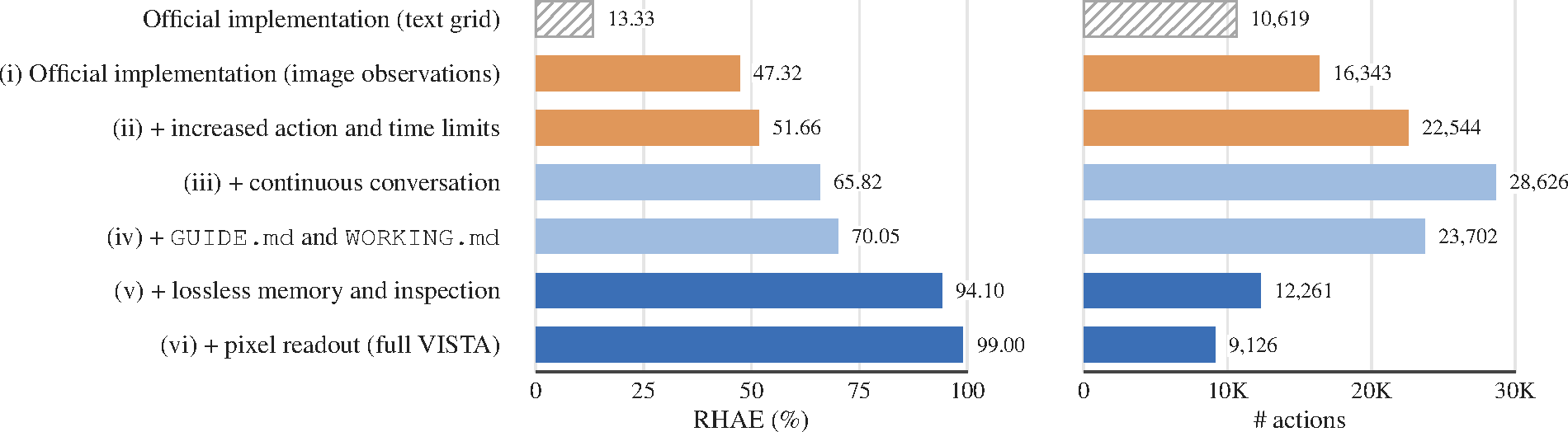
Experiments (§4–5). On ARC-AGI-3, VISTA raises RHAE 40.68 → 100.00 for Claude Opus 5.0 and 13.33 → 99.00 for GPT-5.6 Sol.
-
More context or pixels hurt (Fig. 7). A 780K context gets 93.9 against 99.0 at 200K, and 16× images get 88.3 against 99.7 at 4×.
The per-turn loop and the visual tools. Follow Figure 3d and the tool interface of Appendix A.4.
def render(frame, upscale=8):
    return frame.resize((frame.w * upscale, frame.h * upscale), "nearest")  # a 64x64 grid becomes 512x512

def inspect(memory, views, display=512, max_views=16):
    # view = {turn, frame, region}, region = {x, y, w, h} in display coordinates
    out = []
    for v in views[:max_views]:
        crop = memory[(v.turn, v.frame)].crop(v.region)
        scale = display / max(crop.w, crop.h)  # enlarged to fit the display
        out.append(crop.resize((crop.w * scale, crop.h * scale), "nearest"))  # no smoothing
    return out

def read_pixels(memory, views, palette, max_views=64):
    # view adds rows and columns. Read the center pixel of each cell.
    out = []
    for v in views[:max_views]:
        crop = memory[(v.turn, v.frame)].crop(v.region)
        ys = [crop.h * (r + 0.5) / v.rows for r in range(v.rows)]
        xs = [crop.w * (c + 0.5) / v.cols for c in range(v.cols)]
        out.append([[palette.index(crop[y, x]) for x in xs] for y in ys])  # one color symbol per cell
    return palette, out

def run_game(env, model, prompt, palette, max_actions=2000, context_limit=200_000, upscale=8):
    # 1. Reset the game, archive its first frames and render the observation.
    frames, actions, done = env.reset()  # 64x64 palette grids
    memory = {(0, f): img for f, img in enumerate(frames)}  # lossless visual memory, keyed by (turn, frame)
    history, guide, working, turn = [], "", "", 0  # action log, GUIDE.md, WORKING.md
    context = [prompt, render(frames[-1], upscale), actions]

    while not done and len(history) < max_actions:
        # 2. Let the model reason in free-form text and emit one tool call.
        call = model(context)

        # 3. Run the free tools, which read the memory, the notes or the action log.
        if call.tool == "inspect":
            context += inspect(memory, call.views)
        elif call.tool == "read_pixels":
            context += read_pixels(memory, call.views, palette)
        elif call.tool == "history":
            context += [history[call.start:call.end]]
        elif call.tool in ("read_guide", "read_working"):
            context += [guide if call.tool == "read_guide" else working]
        elif call.tool == "write_guide":
            guide = call.content  # durable rules, kept across levels and sessions
        elif call.tool == "write_working":
            working = call.content  # the level's scratchpad, cleared when the level advances

        # 4. Play one action, archive every returned frame and observe the last.
        elif call.tool == "play":
            turn += 1
            frames, actions, done = env.step(call.action, call.x, call.y)  # ACTION6 clicks (x, y)
            memory.update({(turn, f): img for f, img in enumerate(frames)})
            history.append((call.action, len(frames)))
            context += [render(frames[-1], upscale), len(frames), actions]

        # 5. Near the context limit, save a handoff and restart the context.
        if model.count_tokens(context) > context_limit:
            guide, working = model.save_compact_checkpoint(guide, working)  # no other tool runs until the save
            context = [prompt, guide, working, history, render(frames[-1], upscale)]  # the memory stays addressable
Last updated on November 04, 2026 · Citations from Semantic Scholar & Google Scholar; stars from GitHub, November 2026